
Generative AI online training in India Hyderabad – Master AI Skills in 3 Months
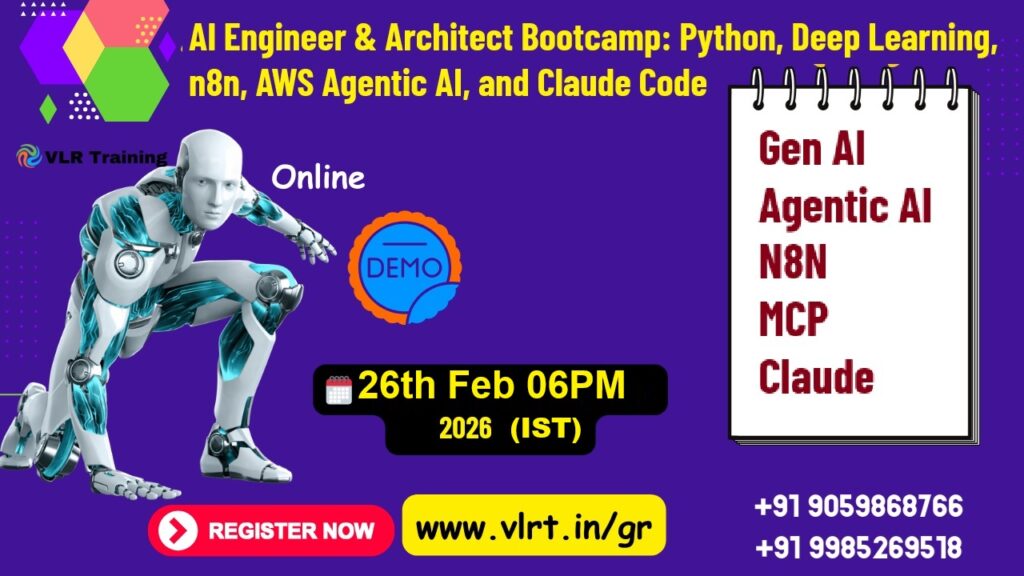
The Complete AI Engineer & Architect Bootcamp: Python, Deep Learning, n8n, AWS Agentic AI, and Claude Code
With
Real time projects
+91 9059868766

What is Generative AI
Generative AI is a type of artificial intelligence that focuses on creating new content. Vlr training provide Generative AI Training. This content can take many forms, including
- Text: Writing stories, poems, articles, summaries, translations, etc.
- Images: Generating realistic or artistic images, editing photos, creating designs, etc.
- Audio: Composing music, creating sound effects, generating speech, etc. Video: Producing animated videos, editing existing footage, etc.
- Code: Writing computer programs in various programming languages.
- 3D models: Creating virtual objects for use in games, simulations, or design.
How does it work?
Generative AI models are trained on vast amounts of existing data. By analyzing this data, they learn the underlying patterns and structures, and then use this knowledge to generate new, similar data.
Common techniques used in generative AI include:
- Generative Adversarial Networks (GANs): These use two neural networks, a generator and a discriminator, that compete against each other to produce increasingly realistic outputs.
- Variational Autoencoders (VAEs): These learn a compressed representation of the input data and then use it to generate new data points.
- Transformer networks: These are particularly effective at processing sequential data like text and have led to significant advances in natural language processing.
Examples of Generative AI in action:
- ChatGPT: A conversational AI that can engage in natural-sounding dialogues, answer questions, and generate various creative text formats.
- DALL-E 2 and Midjourney: AI art generators that can create images from textual descriptions.
- GitHub Copilot: An AI pair programmer that can help write code.
Potential benefits of Generative AI:
- Increased creativity and productivity: It can assist with creative tasks and automate repetitive ones.
- Personalized experiences: It can generate content tailored to individual preferences.
- New forms of art and entertainment: It can create entirely new forms of media and artistic expression.
- Accelerated scientific discovery: It can help analyze complex data and generate new hypotheses.
Generative AI Online Training : Build AI Content Creation Skills (Highlights practical application)
About Generative AI
Early Days (1950s-1960s)
- The Dartmouth Summer Research Project on Artificial Intelligence (1956) marked the birth of AI as a field of study.
- ELIZA (1966), the first chatbot, was developed by Joseph Weizenbaum. It used simple pattern matching to simulate conversation, laying the groundwork for natural language processing (NLP).
Quiet Development (1970s-1990s)
- Recurrent Neural Networks (RNNs) (1980s) and Long Short-Term Memory (LSTM) networks (1997) were introduced, enabling AI to better process sequential data like text and speech.
- Hidden Markov Models (HMMs) and Gaussian Mixture Models (GMMs) were early generative models used to produce sequential data.
The Rise of Deep Learning (2000s-2010s)
- A Fast Learning Algorithm for Deep Belief Nets (2006) by Geoffrey Hinton and colleagues re-introduced Restricted Boltzmann Machines, contributing to the resurgence of deep learning.
- Breakthroughs in image recognition (2012, 2014) by Hinton’s team paved the way for further advancements in AI.
- Generative Adversarial Networks (GANs) (2014) were introduced by Ian Goodfellow, enabling the generation of realistic images and other content.
- Variational Autoencoders (VAEs) and diffusion models emerged as alternative approaches to generative modeling.
- Transformer architecture (2017) revolutionized NLP with its ability to process sequences more efficiently, leading to the development of large language models.
The Age of Generative AI (2018-Present)
- GPT (Generative Pre-trained Transformer) (2018) by OpenAI marked a significant milestone in language generation.
- DALL-E (2021), also by OpenAI, demonstrated the power of AI to generate and edit images from text descriptions.
- Stable Diffusion (2022) and Midjourney (2022) made AI image generation more accessible.
- GPT-4 (2023) further pushed the boundaries of language generation with its expanded capabilities.
- Ongoing research continues to improve generative AI models, leading to even more realistic and creative outputs.
Key Trends and Future Directions
- Increased realism and creativity: Generative AI models are becoming increasingly sophisticated, producing outputs that are often indistinguishable from human-created content.
- Wider accessibility: Open-source models and user-friendly tools are making generative AI more accessible to a broader audience.
- Ethical considerations: As generative AI becomes more powerful, there is growing concern about its potential misuse, including the creation of deepfakes and the spread of misinformation.
- Multimodal generation: Future models are likely to be able to generate content across multiple modalities, such as text, images, audio, and video.
Generative AI is rapidly evolving, and its impact on society is only beginning to be felt. As the technology continues to advance, it is crucial to address the ethical challenges and ensure that it is used responsibly.
Who Can Learn Generative AI?
Aspiring Software Developers:
- This is the target audience. The roadmap provides a clear path to acquiring the necessary skills and experience for a generative AI software role.
Data Scientists:
- Many of the skills overlap, particularly in programming, math, and machine learning. Generative AI knowledge enhances their toolkit for data analysis, pattern recognition, and model building.
Machine Learning Engineers:
- This is a natural progression. The prompt emphasizes deep learning and generative models, essential for those specializing in building and deploying AI models.
AI Researchers:
- While researchers often have strong theoretical foundations, the practical advice on tools, frameworks, and continuous learning is valuable for staying at the forefront of generative AI advancements.
Prerequisites to Learn Generative AI
We will teach all below Prerequisites in our Generative ai Online training Program
1. Foundational Knowledge
- Mathematics: A solid grasp of these concepts is essential:
- Linear Algebra: Vectors, matrices, eigenvalues, and eigenvectors. These are fundamental to understanding how many AI algorithms work.
- Calculus: Derivatives, gradients, and chain rule. These are crucial for optimization algorithms used in model training.
- Probability and Statistics: Probability distributions, statistical inference, and hypothesis testing. These help in understanding and evaluating model performance.
- Programming:
- Python: This is the dominant language in AI/ML. Learn its syntax, data structures, and control flow.
- Libraries: Familiarize yourself with key Python libraries like NumPy (for numerical computation), Pandas (for data manipulation), and Matplotlib/Seaborn (for data visualization).
2. Machine Learning Fundamentals
- Core Concepts: Understand the basics of machine learning, including:
- Supervised, unsupervised, and reinforcement learning: The different types of learning paradigms.
- Model training and evaluation: How models are trained and assessed for performance.
- Common algorithms: Linear regression, logistic regression, decision trees, and clustering algorithms.
- Deep Learning Basics: Get acquainted with:
- Neural Networks: The fundamental building blocks of deep learning.
- Activation functions, loss functions, and optimizers: Key components of neural network training.
- Basic architectures: Multi-layer perceptrons (MLPs).
3. Computer Science Fundamentals
- Algorithms and Data Structures: A basic understanding of algorithms (e.g., searching, sorting) and data structures (e.g., lists, trees, graphs) is helpful for efficient coding.
- Basic software engineering principles: Version control (using Git), modular code design, and testing are valuable for managing AI projects.
Important Note: You don’t need to be an expert in all these areas before starting with generative AI. Focus on building a strong foundation and gradually deepen your knowledge as you progress. You can always revisit specific concepts as needed.
Generative AI Online Training Course Content
🚀 From Foundation to Production
This comprehensive curriculum takes you on a journey from core programming and math fundamentals to building state-of-the-art autonomous agents.
🎓 What You Will Master:
- 🐍 Foundations Master Corporate Python, Statistics, Math, and the core principles of Machine Learning.
- 🧠 Deep Learning Dive deep into Neural Networks, GANs, Transformers (ViT), and the inner workings of LLMs.
- ⚙️ Low-Code Orchestration Build powerful AI Agencies and autonomous swarms using n8n.
- ☁️ AWS Agentic AI Architect secure, scalable agents using Amazon Bedrock, Lambda, and Neptune.
- 💻 Next-Gen Development Revolutionize your workflow by coding with Claude Code (Agentic IDE).
🎯 Your Career Trajectory
Whether you aim to be an AI Engineer, Solutions Architect, or run your own AI Automation Agency, this course covers the entire spectrum of modern AI development.
Generative AI Online Training Demo Videos
GenAI demo By Dhamodhar Telugu
GenAI demo By Dhamodhar English
Register Now Generative ai online training
Certifications for Generative AI
It’s awesome you’re looking into certifications for Generative AI! They’re a great way to formalize your knowledge and demonstrate your skills to potential employers. Here are some of the top certifications currently available, categorized by their focus:
Broad Generative AI Knowledge
- Certified Generative AI Specialist (CGAI™) by the Chartered Institute of Professional Certifications: This program provides a comprehensive overview of generative AI, covering everything from fundamental concepts to ethical considerations and real-world applications. It’s suitable for a wide range of professionals seeking to upskill in this field.
- DataCamp’s AI Fundamentals Certification: While not solely focused on generative AI, this certification provides a strong foundation in AI principles, which are essential for understanding generative models.
Cloud Provider-Specific Certifications
These certifications focus on using generative AI tools and services offered by specific cloud platforms:
- Microsoft Azure AI Fundamentals: Generative AI: This learning path from Microsoft provides foundational knowledge on generative AI and its applications within the Azure ecosystem, including large language models and Azure OpenAI services.
- Google Cloud Generative AI Learning Path: Google Cloud offers a variety of resources, including courses and labs, focused on their generative AI tools and services. While not a formal certification, completing this path demonstrates proficiency in using Google’s generative AI offerings.
- AWS Generative AI Learning Path for Developers: Amazon Web Services (AWS) provides a learning path that covers building generative AI applications using services like Amazon Bedrock. This path includes modules on prompt engineering and practical exercises.
Specialized Certifications
These certifications delve into specific aspects of generative AI:
- NVIDIA-Certified Associate – Generative AI LLMs (NCA-GENL): This certification from NVIDIA focuses on foundational knowledge in developing, integrating, and managing AI-driven applications utilizing generative AI and large language models (LLMs) with NVIDIA solutions. 1 1. www.projectpro.io www.projectpro.io
- MIT’s Applied Generative AI for Digital Transformation: This intensive program from MIT focuses on the application of generative AI in digital transformation, covering topics like prompt engineering, automation of workflows, and ethical considerations.
Things to Consider When Choosing a Certification:
- Your current skill level and background: Some certifications are designed for beginners, while others require prior knowledge of AI/ML.
- Your career goals: Consider whether you want to specialize in a specific area of generative AI or gain a broader understanding of the field.
- The specific tools and technologies you want to learn: Some certifications focus on particular frameworks or cloud platforms.
- The credibility and recognition of the certifying organization: Choose certifications from reputable institutions or organizations.
By carefully considering these factors, you can choose the certification that best aligns with your needs and aspirations. Good luck on your generative AI journey!
These certifications are valuable for demonstrating your Boomi expertise to employers and clients, enhancing your career prospects in the integration domain. Dell Boomi Online training.
Job Market for Generative AI
The job market for Generative AI is absolutely booming! It’s one of the hottest areas in tech right now, with demand far outpacing supply. Here’s a breakdown of what makes this field so exciting:
High Demand:
- Across Industries: Generative AI is impacting everything from art and entertainment to healthcare and finance. Companies across the board are looking for talent to help them leverage this technology.
- Variety of Roles: The demand spans various roles, including:
- AI/ML Engineers: Develop and train generative models.
- Data Scientists: Analyze data and fine-tune models for optimal performance.
- Research Scientists: Push the boundaries of generative AI through cutting-edge research.
- Software Developers: Build applications and tools that utilize generative AI.
- Product Managers: Guide the development and deployment of generative AI products.
- AI Ethicists: Address the ethical implications and societal impact of generative AI.
- Competitive Salaries: Generative AI skills are highly sought after, leading to competitive salaries and benefits packages.
Growth and Future Prospects:
- Rapidly Expanding Field: Generative AI is still in its early stages, with immense potential for growth and innovation.
- New Applications Emerging: As the technology matures, we can expect to see even more creative and impactful applications across various industries.
- Increased Investment: Companies and research institutions are investing heavily in generative AI, further fueling its growth.
Key Drivers of Demand:
- Automation: Generative AI can automate tasks, improve efficiency, and reduce costs.
- Personalization: It enables the creation of personalized content and experiences.
- Innovation: It opens up new possibilities for product development and creative expression.
- Problem-Solving: Generative AI can be used to address complex challenges in various fields.
Where to Find Jobs:
- Tech Companies: Major tech companies like Google, Meta, Microsoft, and OpenAI are actively hiring in generative AI.
- Startups: Many AI startups are focusing on innovative applications of generative AI.
- Research Institutions: Universities and research labs offer opportunities for research and development in generative AI.
- Job Boards: Platforms like LinkedIn, Indeed, and Glassdoor feature numerous generative AI positions.
- Company Websites: Check the career pages of companies working with generative AI.
If you’re passionate about AI and eager to be at the forefront of this technological revolution, now is the perfect time to explore the exciting job market for generative AI.
Generative AI Use cases
1. Content Creation and Enhancement
- Text Generation & NLP:
- Automated Content Writing: Generate articles, blog posts, marketing copy, and even creative content like poems or scripts using GPT-4 (accessed via OpenAI’s Python library) and NLP techniques for text processing and analysis.
- Code Generation: Translate natural language descriptions into code snippets using models like Codex, streamlining software development.
- Summarization and Paraphrasing: Condense lengthy documents, extract key information, and rephrase text while maintaining its meaning, using NLP libraries like NLTK and spaCy.
- Chatbots and Conversational AI: Build interactive chatbots that can engage in natural conversations, understand user intent, and provide helpful responses using libraries like Rasa, combined with powerful language models for natural language understanding (NLU).
- Image Generation & Computer Vision:
- AI Art and Design: Create stunning visuals, generate unique artwork, and explore new artistic styles using DALL-E 2, Stable Diffusion (accessed via Python libraries like
diffusers), and Midjourney. - Image Editing and Enhancement: Manipulate existing images, generate variations, and enhance image quality using OpenCV and Pillow, combined with deep learning models for tasks like image inpainting or style transfer.
- Object Detection and Recognition: Train models to identify and classify objects within images, enabling applications like automated image tagging, visual search, and security systems.
- AI Art and Design: Create stunning visuals, generate unique artwork, and explore new artistic styles using DALL-E 2, Stable Diffusion (accessed via Python libraries like
- Audio Generation & Processing:
- Music Composition and Sound Design: Generate original musical pieces, create sound effects, and even synthesize realistic voiceovers using libraries like Librosa and PyDub, combined with deep learning models for audio generation and manipulation.
- Speech Recognition and Synthesis: Convert spoken language to text and vice versa, enabling applications like voice assistants, transcription services, and accessibility tools.
2. Data Analysis and Prediction
- Predictive Modeling with ML:
- Customer Churn Prediction: Build models to predict customer churn, enabling proactive interventions to retain valuable customers.
- Fraud Detection: Identify fraudulent transactions and patterns in financial data, improving security and risk management.
- Personalized Recommendations: Develop recommendation systems that suggest products, services, or content tailored to individual user preferences, enhancing user experience and engagement.
- Data Augmentation and Synthesis:
- Generate Synthetic Data: Create realistic synthetic data to augment training datasets, especially in situations with limited or imbalanced data, improving the performance and generalization of machine learning models.
- Privacy-Preserving AI: Generate synthetic data that retains statistical properties without revealing sensitive information, enabling data sharing and analysis while protecting privacy.
3. Personalized Experiences
- Adaptive Learning: Create educational materials and platforms that adjust to individual learning styles and pace, providing a more effective and engaging learning experience.
- Personalized Content Recommendations: Recommend content, products, or services based on user preferences and behavior, increasing user satisfaction and engagement.
- Targeted Marketing: Generate personalized marketing messages and advertisements tailored to individual customer profiles, improving campaign effectiveness and ROI.
4. Scientific Research and Development
- Drug Discovery: Generate novel molecular structures with desired properties for drug discovery, accelerating the development of new treatments and therapies.
- Materials Science: Design new materials with specific characteristics using generative AI to explore the vast space of possible materials, leading to advancements in various fields.
- Climate Modeling: Generate realistic climate simulations to study the impact of climate change and develop mitigation strategies.
This is just a glimpse of the vast potential of generative AI using ML, NLP, DL, and Python. As these technologies continue to evolve, we can expect even more groundbreaking applications to emerge, shaping the future of various industries and our daily lives.
Generative AI Online Training Common Faqs
What basic skills are helpful for getting started with Generative AI?
Basic computer literacy, familiarity with programming concepts (even at a high level), and a grasp of fundamental mathematical concepts (like probability and statistics) are beneficial. However, many tools offer user-friendly interfaces that require minimal coding. We provide Generative AI Online Training
Do I need to be a programmer to use Generative AI tools?
Not necessarily. Many user-friendly platforms and applications provide access to generative AI models without requiring extensive programming knowledge. However, programming skills are essential for developing new models, fine-tuning existing ones, and integrating them into complex systems.
What programming languages are most commonly used in Generative AI?
Python is the most popular language due to its rich ecosystem of libraries like TensorFlow and PyTorch, which are widely used for deep learning.
What are some key concepts I should learn to understand Generative AI better?
Key concepts include machine learning, deep learning, neural networks (especially recurrent neural networks (RNNs), convolutional neural networks (CNNs), and transformers), training data, algorithms, and model evaluation metrics.
What educational qualifications are needed for a career in Generative AI?
A bachelor’s degree in computer science, data science, mathematics, statistics, or a related field is a good starting point. A master’s or Ph.D. in a specialized area like machine learning or artificial intelligence is often preferred for research-oriented roles. We provide Generative AI Online Training
What are some potential career paths in Generative AI?
Potential career paths include machine learning engineer, AI researcher, data scientist, deep learning specialist, prompt engineer, AI artist, and AI product manager.
What is a “prompt engineer,” and why is it becoming important?
A prompt engineer is someone skilled at crafting effective prompts (inputs) for generative AI models to elicit desired outputs. As these models become more sophisticated, the ability to create precise and creative prompts is increasingly valuable.
What is the job outlook for Generative AI-related roles?
The job outlook is very promising, as the demand for professionals with expertise in Generative AI is rapidly increasing across various industries.
What exactly is generative AI? How is it different from other types of AI?
Generative AI is a type of AI that can create new content, ranging from text and images to audio, code, and even 3D models. It differs from other AI that primarily focuses on tasks like classification or prediction.
How does generative AI work? What are the underlying technologies?
It often uses deep learning models, particularly neural networks, trained on vast amounts of data. These models learn the patterns and structures within the data and then use that knowledge to generate new, similar content.
What are some examples of generative AI in action?
Examples include text generation (like me!), image generation (DALL-E, Midjourney), music composition, code generation, and even drug discovery.
Can generative AI think or understand like humans?
No. While it can produce impressive results, it doesn’t possess consciousness, sentience, or true understanding. It works by recognizing patterns and probabilities, not by having genuine comprehension. We provide Generative AI Online Training
Is generative AI always accurate or reliable?
No. It can sometimes produce incorrect, nonsensical, or biased outputs, especially if the training data is flawed or if the prompts are ambiguous.
What are the limitations of generative AI?
Limitations include the need for large amounts of data, potential biases in the output, difficulty in controlling the creative process, and the risk of misuse.
What are the ethical concerns surrounding generative AI?
Concerns include the spread of misinformation, copyright infringement, job displacement, and the potential for malicious use. We provide Generative AI Online Training
How can we ensure responsible use of generative AI?
This involves developing ethical guidelines, promoting transparency, addressing biases, and fostering public awareness.
Will generative AI take my job?
While it may automate certain tasks, it’s more likely to augment human capabilities and create new job opportunities.
How can businesses use generative AI?
Businesses can use it for various purposes, such as content creation, marketing, product design, customer service, and research and development.
What industries are most impacted by generative AI?
Industries like media and entertainment, marketing, advertising, design, software development, and healthcare are significantly impacted. We provide Generative AI Online Training
How can I learn more about generative AI?
There are numerous online resources, courses, and tutorials available, as well as books and research papers.
What tools and platforms are available for using generative AI?
Many tools and platforms exist, ranging from cloud-based APIs to open-source libraries and user-friendly applications.


